Monday, 14 March 2016

Low Barns


Yesterday I woke up to thick mist, and thought, yes! Spring! First properly misty morning we’ve had for ages, and there was something about the quality of the light that made it clear it was going ‘get out’ as they say round here; the sun would shine and we would have springtime at last.

I have got so fed up with being cold this winter. It was a slow starter. Autumn was mild, but then after Christmas it rapidly got colder and it’s been damp and cold ever since. Yesterday though! Fantastic. So I took myself off to Low Barns Nature Reserve, which I like to do regularly whatever the weather. It’s only a three mile drive, and it’s open every day; it has a café, and as I’m a member of Durham Wildlife Trusts I get free parking. What’s not to love? And of course it has wildlife. That’s the whole point.

For those who don’t know this lovely reserve, the River Wear run through it and we’re high enough upstream for it to be a lively and boisterous river rather than the sluggish thing it becomes downstream. There’s a decent sized lake with islands, and a series of huge reedbeds – all made from reclaimed land that used to be gravel pits, I believe. There are plenty of hides, decent footpaths, hidden corners, and huge numbers of birds. Don’t ask me what they are – I used to be good on birds, but seem to have forgotten all of them other than the usual suspects – chaffinches, blue tits, etc. The great thing about Low Barns is you’ll also see the ones you don’t see in your garden, so you’re highly likely to see swans, cormorants (unless they’re shags – sorry, don’t know the difference), geese, herons, woodpeckers and nuthatches. I’ve seen huge flocks of peewits occasionally, and one brilliant time I actually saw a kingfisher.


Yesterday, however, was more about the flowers than the birds as far as I was concerned. There were still plenty of clumps of snowdrops about, though they were just starting to go over. The miniature daffodils were still blooming too, but the exciting yellow was the first dandelion of the year, the first coltsfoot, and the early flush of gorse flowers. By the time I got there, which was about two o’clock, the mist had pretty much burnt off in the sun though it was still hazy; warmish, but you wouldn’t want to be without your jacket.

I walked round the lake, and a little along the path by the river, where, because of the recent flooding, the snowdrops were poking up through sand rather than the more normal soil, and there was driftwood and detritus all over the place. A fair number of trees have been cut back to open up vistas and let in more light and the catkins were starting, as well as the first, bright green leaves. There was even some blossom in a sheltered spot.

The café provided a decent scone and pot of tea, as ever, and the car park was full, but I still hardly met anyone. They were probably all in the hides, peering out with improbably long camera lenses.

I love this place. Been coming here for years. When my kids were little, I brought them, of course – more recently I’ve brought my granddaughter. I’ve taken school trips round, I’ve been round with both husbands, and if I have anyone staying with me I always try to include a trip to Low Barns. I saw a field vole one time – a ferret another. I live in hope of an otter, and I would absolutely love to see the kingfisher again. 


Sunday, 13 March 2016

Painting Dark Against Dark

I’m working on a commissioned portrait at the moment that is proving tricky. The sitter is dressed in a black suit and Masonic regalia. This is to be a formal and traditional portrait, so I’ve been looking at hundreds of the things for ideas, and have decided I definitely want a dark background. I’ve reached the stage where I’ve done all the under-painting and have had some success in that it certainly looks like the sitter, the pose is good, and the regalia is taking shape. The problem is the black suit. The colour I’ve chosen for the background is a very dark green, and whilst in daylight you can see the change from black to green, by electric light the distinction disappears completely. I’ve tried lightening the background a little by adding a yellow glaze, but that still gets swallowed up in electric light and is in danger of looking garish in daylight. The suit itself is matt black, so I can’t use the tricks I might use if it were black satin with all the light reflections. I haven’t fallen into the trap of using black paint at least, though I’ve come perilously close with a bit of Payne’s Grey, a colour I rarely use.

To try to sort this problem out, I took myself yesterday to the Bowes Museum, which is the nearest art gallery to my location likely to contain portraits that might help. There are formal paintings closer to home – Bishop Auckland Castle has plenty of paintings of past Bishops – but the problem there is the really good portraits look in desperate need of a clean so it’s hard to see what the artists did to solve the problem, and the more modern ones that don’t need cleaning tend to have light backgrounds, which is not the effect I’m after.

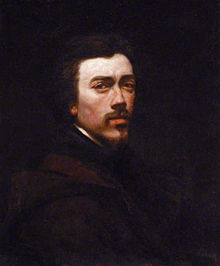
There are some fantastic portraits in the Bowes. My favourite is an 1874 self portrait by French realist François Bonvin. He’s wearing very dark clothes – so dark you can barely make out whether it’s an overcoat or monk’s habit or what – has dark hair, and has painted himself against a very dark background. This means you see the face and only the face because the rest virtually merges together. This ought to matter, but in this particular painting it absolutely doesn’t, so it shows beyond a shadow of a doubt that in certain circumstances a background/clothing merge can be made to work. It still makes me nervous of attempting such a thing. I am no Bonvin. 


Another painting that does something similar, though has more light in it generally is a fabulous portrait of Lord Harry Vane by George Frederick Watts. Unfortunately I can’t find that one on the internet so can’t show it. He is wearing a dark suit and one of his shoulders almost merges into the background, but he has a shock of white hair and there is other brightness in the picture (a medal, his white shirt) so there’s more of a sense of balance, if less drama, than the Bonvin. The suit itself, though clearly black, is painted in shades of grey, but where it meets the background there is still virtually no distinction. It works because the viewer knows where his shoulder must be, so sees it anyway. It’s not a trick of the eye so much as the use of logic and seeing what you know must be there.

The Bowes is also currently hosting a selection of photographs by Robert Mapplethorpe, and some of these do exactly the same thing – the tonal difference between a shoulder in a dark shirt and a dark background can be incredibly slight, but the eye still sees it and knows exactly what it’s seeing.

So maybe the answer is not so much in the tonal values as in the draftsmanship. If the suit is well enough painted and clearly shows how the fabric forms around the body underneath, then a major distinction in tonal values is not required. The viewer’s brain will work it out. This puts the onus on me as the artist to get the suit right. I must stop worrying so much about the distinction between the edge of the suit and the dark of the background and work more on suggesting that there really is a solid body underneath that thick black fabric. If I can do that, the rest will take care of itself.

That’s the theory, anyway. The next few months of painting will see whether I can pull it off. There is no hurry for this one to be finished, luckily, so I have the luxury of working in oils rather than acrylics and being able to let glazes dry completely – also I have ready access to the sitter whenever required, so I don’t have to rely on guesswork.

The next problem will be the regalia. The trick there is going to be how to suggest or the detail without actually painting it in, because I’m no miniaturist so am absolutely not going to start working in a brush with one squirrel hair. The trick here is to see how the light catches the braid, and for that there are plenty of artists to show me the way from Gainsborough to Manet – but that’s a problem for another day.   

Friday, 11 March 2016

Writing a poem when you have not an idea in your head

Since December last year I’ve been writing an average of 1000 words a day, the point being if you’re not writing you’re not a writer, and 1000 feels like a sensible and achievable total. The words comprise a mix of short stories, flashes, poems, and blog posts. I haven’t written a poem for about a week, so I’d like to do one, but I don’t have a single idea in my head at this moment, so I thought it might be an interesting exercise to write down the process, and see if a poem comes out of it at the end.

Facebook has already proved helpful. I have a possible title. Someone has noted that today is the anniversary of Mary Shelley’s ‘Frankenstein’, and they’ve helpfully included a quote: “the world to me was a secret which I desired to divine”. I like that, and I think I’ll use it.

Sometimes there will be a word or phrase that strikes me from one of the many prompts lists that appear on various workshops and forums on the internet, but today nothing is working, so I’m going to go to my alternate source – images. Street photography is invaluable for story and poetry ideas, and one of the best street photographers around is ‘SUDOR’ on deviantART, so that’s where I’m going. My notifications are usually packed with a good selection of his photos, and today is no exception. Having had a quick browse, I see there are several that include a little girl. I could use her as the character who sees the world as a secret which she desires to divine. I’ll go through the photos one by one and jot down descriptions of what I can see, and perhaps something will grow out of my observations. I’m a great believer in ‘things’, ie concrete objects. I don’t want to note if the girl is smiling – I want to describe what she is looking at that is making her smile.

First photo. I don’t know if she’s smiling or not as it happens, as it’s a back view. She’s on the Paris Métro, and she’s small, maybe about five years old, dressed in a tartan raincoat, white ankle socks, smart little shoes. She’s right at the front of the train, and has climbed the ladder that’s attached to the end of the compartment so that she can lean across and see through the window that gives her a view of the driver’s cabin. She’s holding on tight. She can’t get through the door into this other world. Her side has a carpet, shiny poles, posters – the driver’s side has a huge window, daylight, windscreen wipers – it’s raining, so we’re not in a tunnel. Most children would be pulled straight back down by whoever’s in charge of her, but she looks relaxed and comfortable. I think she’s been up there a while, holding on securely while the train rocks and buffets.

Second. In the Quartier de la Défense, a wide paved path that curls like a snake, she’s running along it, and she could run in a straight line but she’s choosing to follow the curves, so although she’s running, she’s not in a hurry, she has time to enjoy the architect’s design.

Third. She’s not in this photo at all, but it doesn’t matter. I’ll imagine her standing at the photographer’s side and looking in. The scene is a hairdresser’s shop. The hairdresser has short cropped dark hair and big earrings, she’s wearing a dark jumper, a suede mini-skirt and suede platfrom boots, she’s perched on a stool on casters. The lady having her hair done has turned to look at the camera – at the girl – with a ‘what do you think you’re doing here?’ kind of a look. She has an unpleasant long, horsey face. I’ve taken an instant dislike to her; she is supercilious – but I mustn’t think in such terms. I’m not interpreting at this point, I’m trying simply to observe, note down as if I were going to draw the scene. Okay then. She has one hand up to her face, and has her long thumb pressed against the side of her mouth, the fingers of the hand are curled over. Eyebrows are raised. There’s a chair in the way so I can’t see her body, but I can see her feet, in patent leather slingback shoes, lowish heels. The hairdresser has a small smile on her face as if she’s thinking about something good that’s going to happen when she leaves work tonight. I don’t think anything good is going to happen to the lady in the chair.  

Fourth. This one’s odd. It’s a Paris street. There’s a man, sixtyish, business suit. He has a small attaché case, an old fashioned leather one – and he’s balanced it on his head. He is standing perfectly motionless with a case on his head! No, I don’t know either.

Fifth. A dark alleyway. All old cities have these. It has high walls either side, stone built, repointed so many times you can hardly see the stones any more except where the pointing has fallen away. Dark mossy steps, well worn. Granite setts, or similar. Very damp. Four or five steps, every four or five yards. It alleyway bends slightly so that you can never see very far ahead. Nobody else there. Splashes of graffiti, but old, scrubbed away, so they just look like coloured mosses. Brown leaves in the corners where the wind has dropped them.

Sixth. This is the first photo where we see her properly – and incidentally, it’s not the same child, but for the purposes of my narrative it can be. There is more tartan after all – she’s wearing a tartan skirt that’s too small for her and a vest top. Her hair’s cut in a bob, her legs are long and very skinny. She’s leaning against a wall, concrete render, the side of a house. There’s a ventilation grill low down. The window is above her head, painted wooden frame, net curtains, iron bars across the front. One casement is open, and there’s a tabby cat that’s come out onto the ledge, it’s reaching down one paw towards the girl’s head, and I think she knows it’s there. She’s keeping very still, it reaches further and just pats the top of her head.

Seventh. The Parc de Sceaux, a wide, wide, grassy avenue covered in autumn leaves, trees either side. She’s riding her bicycle pell-mell, nobody else is anywhere near.

Eight. Her parents’ car. They are moving furniture. There’s a roof rack, a mattress on top of the roof rack, and then an unidentifiable piece of wooden furniture – it’s covered with a tarpaulin which is tied to the roof rack but also secured to other parts of the car, like the wing mirrors and the boot, by long ropes. The bonnet is up and father’s looking into it, mother’s got her hand on one hip and the end of one of the ropes in her other hand. The car door is open. It’s looking seriously unsafe.

Nine. She’s in a library, standing in a quiet corner surrounded by hundreds upon hundreds of books, some of the lower shelves have had books pulled out and their higgledy-piggledy on the floor. She has her hands behind her back and is scowling at anyone who comes past. The shelves are very close together.

Ten. Back outside, the Rue Mouffetard, an ancient lady carrying a capacious wicker basket and a black cane, bent double, walking past scaffolding that’s protected by a fence of what looks like bamboo. Behind the fence, peeling posters. I’ve seen this one before – I recognise the ‘Emerson, Lake and P...’ poster. I wrote a poem about it ages ago. Must be the same photo. Doesn’t matter. The impression of the scene is that this grimy street has been like this for ages.

Eleven – I’m in two minds whether to use this picture or not, as it’s London and all the others have been Paris. It shows a woman with a huge dog. Massive. It’s standing its ground and she can’t move it. There are skid marks on the paving, and it’s almost as if the dog has caused these. I can’t get over how big this dog is. Maybe it’ll have to be in the poem anyway. I saw two Bernese mountain dogs outside the supermarket yesterday and they were just as big – everyone was looking and commenting. I think you never outgrow the joy of seeing an absolutely huge dog.

Twelve. Here she is with her two friends. She’s in her tartan skirt again, and all three of them are wearing clothes that look like hand-me-downs. It’s the Boulevard de Ménilmontant. Scruffy kids, one’s barefooted, but they look very very happy.

That’s enough pictures. I’ve now closed the window on the computer where I was bringing them up, and I’m going to read through what I’ve written so far and see if anything is gelling. I’m still thinking the idea of tying these images together with the little girl is a possible, but I’m wondering if her age needs to be less specific, if they need to be snapshots of different times with her looking back on her childhood. Maybe she’s the woman in London with the huge dog, remembering her Parisian childhood. Perhaps she was very poor – but now she isn’t, hence the dog.

The next stage will be to copy all of this into a fresh document, delete all the words that won’t be included in the poem, and see what’s left; it should be a reasonable set of snapshots. Then I’ll go away and do something else for a while, letting the images gel in my mind. At some point a story will emerge, but I don’t yet know what it is. Some items will go. I’m not sure about the colour – I think this needs to be in black and white, so to speak, it needs to be looking back; childhood through the adult’s eyes. Possibly she is very old now, and these memories are fragmented. Perhaps she’s the old lady with the wicker basket rather than the child seeing her – or perhaps she’s both. Now that’s an angle I like. May well use that one.

I now have to stop writing and start thinking. I think a poem will emerge. It may only end up eight or nine lines long, but that’s fine. Distilling the essence of what I’ve seen and finding a narrative thread is all that’s required, and if that turns out to be very short, it’s no problem. The process is the thing, and the process can be a joy; the teasing out of images, finding exactly the right words to express something, getting into the mind of the protagonist. I write lots of poems, but I’m essentially a story-teller. They have to have character, voice, theme – all the elements of a story. They are no more ‘pretty pictures’ than my artwork. They get under the skin, and the deeper the better. As Mary Shelley said: “the world to me was a secret which I desired to divine”.

Thursday, 10 March 2016

Hairy Arms and Icebergs

I’ve never much wanted to read Hemingway, having always been put off by the macho image and the bullfighting and hunting, etc. Didn’t think someone like that would have anything to say to someone like me. Then on one of my regular charity shop browses for bundles of books to keep me going, I came across ‘A Farewell to Arms’ and thought at 75p I might as well give it a go. It was entirely opposite to my expectations. I warmed to the central character, I found much of it tender and touching and the violence was never glorified in any way – quite the reverse. I had a few weeks of wishing I’d discovered him earlier, wishing he turned up in charity shops more frequently (I have difficulty affording new books at the moment) but then I had a brainwave – birthday coming up: ask Mother for some Hemingway. So I did, and she duly obliged with three more novels. I’ve just finished ‘Fiesta’ and absolutely loved it, even though a good proportion of the book is in Pamplona, there are bulls, they die – though one manages to gore a man to death in passing. And you know what? I get it. I get what Hemingway was saying about bullfighting, why it’s there, what it means. I get it in the spirit of the literature. I am not someone who would ever go to a bullfight, and I would happily sign petitions and demonstrate against the vile ‘sport’ – but in terms of the book, I absolutely get it.

A similar thing happened to me in my teens when I was going through a John Masters phase. I’d read a lot of the Indian novels, but then came across the Spanish one: ‘Fandango Rock’ which is very much a bullfighting novel. I hated the idea of bullfighting, but Masters really understood what it was all about and took it to the heart of his novel and made it work. It’s years and years since I read that book, and I possibly won’t read it again ever because I think one outgrows Masters at some point. He is very much an author to be read in one’s teens; fabulous storytelling, great characters, authentic settings, and sex scenes that are erotic rather than cringe-making, so he’s perfect when you’re fifteen or sixteen. He is also very full on with his prose – it’s rich and gorgeous. Very different to Hemingway, with his iceberg style – and that doesn’t mean he’s cold. Far from it. It’s referring to the fact that most of what is really happening is under the surface. Hemingway was a journalist first, so he reports what happens in a clipped and clear way. It’s left to the reader to work out what the real story is, and there will be much, much more beneath the surface than above, hence the iceberg analogy. He’s supposed to have pretty much invented this, apparently. I disagree. I reckon if anyone invented it, it was Jane Austen, because she does exactly the same thing. She tells you what people said and what happened. She doesn’t do a Bronte and delve deep into their emotions and pour them out gushingly in purple prose. Now, I love Charlotte Bronte in particular, but I sometimes find her completely unreadable because she will explain every last feeling in as much detail as she possibly can. Austen and Hemingway don’t do that, and the result is you are more likely to choking back the tears at the end of ‘Persuasion’ or ‘Fiesta’ than you are at the end of the infuriating ‘Villette’, and that’s because there is SO much going on underneath, you are left exhausted, whereas you feel with Charlotte Bronte, she’s the one who’s left exhausted at the end of the novel rather than the reader.

I have a thing I do with authors I love – unless they are hideously ugly, and I can’t bear to look at photos of them, I like to draw their portraits. It’s partly a sort of ‘thank you’ letter to them for the books, and partly self-indulgence, and that irresistible strange alchemy that happens when you study someone’s face and draw them. By happy coincidence, we were doing portraits in my art class this morning. (By ‘my’ I mean the one I attend. I don’t teach it. Wouldn’t know where to begin.) So I thought, yes! Hemingway! Today’s the day. Ideally when I draw someone who I haven’t met, I watch film of them on YouTube and make a composite drawing from various images I find online, but I was short of time so thought I would simply pick a photo I liked and work from that. There’s a great one of him actually engaged in writing. I thought I’d get the basic outline in before I went to my class so that I wouldn’t waste time there trying to get it right. Glad I did, because the method we were being taught this morning would have been incredibly difficult to get right for me – it involved careful measurement and ratios and all that stuff. Now, for me, there are three ways to get a likeness. Best – you trace it. Next best – grid it. Third best – entirely freehand. I wouldn’t even consider doing the careful measurement of, say, an eye, and then seeing how many eyes fit into the distance between the right nostril and the Adam’s apple. So I listened to the teacher giving the explanation and demonstration of this method, and her encouragement to follow it, and as usual, I went my own way, and was thoroughly relieved I’d thought to trace the outline first so I knew my proportions were broadly correct. Then it was simply a question of sitting down with my favourite Conté pencil and getting on with it. This sort of thing takes far longer than you expect, and men with hairy arms – well, you can get locked into those hairs. I have a thing about men with hairy arms. I am very fond of such things. I spent far too long enjoying his arms – but I did also get his eyes, glasses, head, nose, mouth, bit of beard, etc, broadly shaded. Still a long, long way to go. The question is, will I be able to resist finishing this one off until next Thursday? We have another portrait session then to carry on with what we started this week. If I succumb to temptation, which is highly likely, I’ll finish him on Sunday if not before, and then I will have to think of someone else to draw. Actually, that’s probably not too much of a hardship. I could always do him again.

I have become ridiculously fond of Ernest Hemingway. 


Friday, 4 March 2016

The Ritual of Cleaning

I have just spent a couple of hours cleaning and tidying the house because my eldest daughter is coming to visit. We all do this. We all forget that the person who is visiting was the messiest person in the world when they lived here, and therefore to tidy up mess for them is downright silly. They wouldn’t notice anyway, plus the mess is nowhere near as bad as it was when they lived here.

The specifics put a slightly different complexion on the matter. My daughter, Sarah, is autistic with profound learning difficulties. This means even if she objected to the mess, she would have no way of telling me as she has no speech and virtually no signing ability. The carers who will be delivering her to my door probably won’t come into the house, so I’m not cleaning the place up to impress them. I’m doing it because... it’s what you do. It’s an excuse to get the place into some sort of order for one thing. I am BAD at household chores. I do have a vacuum cleaner, but it’s in the understairs cupboard and there’s a heavy artist’s easel in front of it which I feel curiously disinclined to move, so the pine needles from the Christmas tree (and yes, I’m writing this in March) will have to stay until the painting is finished, and this is a HUGE painting which I expect to take several more months. I’m very good at making excuses. As for dust, I had years of old cobwebs accumulating on the ceiling until a few days ago, which I could have dealt with using a feather duster, but when, a few months ago, I located my feather duster I found the feathers had been eaten away by mites so I chucked it out. I finally replaced it with one that cost all of a pound and is telescopic so will reach into the corners easily, and I have actually cleaned away the cobwebs. They must have been there for years. I have lived in this house for twenty-six years, and am not sure I’ve dusted the ceilings before, because ceilings shouldn’t really get dusty. I also did the hallway for the first time ever – in most households, the hall would have been redecorated within twenty-six years, which would have spruced it up, but my hall has wood panelling which you don’t decorate as it’s a nice original Edwardian feature, so the dust has been clinging to it for a long, long time. It’s amazing how nice it looks now. I must dust it again in ten years or so.

My daughter is visiting because the carers will have realised it’s Mother’s Day this Sunday, so she needs to make her duty visit. That’s fine with me, and it’ll be fine with her. She likes coming here. She has a ritual – she goes into the kitchen for a piece of bread and marmite, then she goes to the toilet to have her pad changed, then she settles down in her favourite armchair and does nothing for an hour or so. I put on some music, which she enjoys, and she plays quietly with a few old toys and usually tries on one of my hats, an orange felt one that’s too big for me so I never wear, but she likes it.

None of this activity requires the house to be cleaned.

I know if I decided to call on my own mother, she would do exactly the same thing. She would go round the whole house tidying and dusting. She would wash the doors to get rid of any grubby bits round the handles. She wouldn’t do any of it very efficiently because she’s elderly and only partially sighted, so tends not to see dirt, but she’d still do it, and I’d only know she’d done it because it’s what she always used to do when visitors were expected. I suppose it’s a ritualistic thing. We want a sense of occasion. I’m aware that there are other women who are obsessive cleaners, and whose houses are pristine at all times, but I can’t get into that mindset. The hours they must spend! I would sooner be writing or painting or just about anything else.

***

My daughter has arrived, and has come in bearing a most acceptable gift of a bottle of Rosé (I must remember to thank the carers). As predicted, she’s now sitting quietly in her favourite chair, moving in time to the music. She’s enjoyed a long glass of water, but unusually, hasn’t wanted anything to eat. There are birthday cards on the mantelpiece, so she had a good look at those, but otherwise made no ‘comment’ on any changes, despite me having picked up piles of old newspapers and cleared my workspace so that you can actually see the table – but why would she? I’ve been clearing for her home visit for years now, so it’s how she expects it to be and it’s not worthy of comment. One day I must have the courage to leave it exactly how I like it to be, and see how she reacts. One of the qualities of autistic people is their ability to see even the minutest change. She has never objected to change as such, so I don’t think she’d be upset – but I’d love to know if she’d be pleased, if perhaps she’d be thinking ‘Yes! This is how it used to be. I like this!’

Thursday, 3 March 2016

Drawing Christine

I’ve recently been working on a set of portraits of Christine Keeler. I wouldn’t normally do more than one picture of somebody I don’t know, but I did the first, and Fionn Wilson, the artist who is masterminding the Christine Keeler project, suggested that a set of three or four might be a good idea, so I though, yeah, okay. She didn’t want copies of photos, which is absolutely fair enough. Anyone with rudimentary drawing skills can copy a photograph, but think of your own passport photos. Do they actually look like you? Highly unlikely. Sometimes there’s no choice but to work from a photo, but even if you can’t get a sitting with the person you’re drawing, there are other ways, especially if they’re someone in the public eye like Keeler. I went to that font of all moving images: Youtube, found a documentary with plenty of video, and watched until I got more of a feeling of what she really looks like, until I started to feel that any image I produced might be in with a chance of getting under the skin and showing something of the real person rather than the superficiality of the outer features. The first portrait I did had her resting her chin on her hand, looking downwards, serious, the next also had a serious expression, so in the third I wanted to capture, if not exactly laughter, something akin to amusement/bemusement. In that one she looks as if she’s saying, ‘I can’t believe you really just asked me that question’ which must have been something she often thought as she was being interviewed.  I think I managed it okay, because each time I drew her I felt I got closer to the real person, and each portrait looked more like her in some inexplicable way. She is someone I am unlikely ever to meet, but the more I draw her, the more I want to meet her, and this is often the case with portraiture, because there is something weirdly intimate about staring intensely at someone’s features when they can’t look back. 


I like to work relatively quickly, so these drawings took no more than an hour or two to complete. I’m going to make a note of the specific technique here, because the way I draw changes every few months and I’ll want to look back and check how these ones were done.

First of all I do a very careful line drawing using a sharp Derwent Onyx pencil. This is just outline to make sure the proportions are spot on, concentrating on eyes (easy), nose (okay) and mouth (often surprisingly difficult). I also indicate dark areas, not with shading, but simply by encircling them. It means the drawing looks like the plan for ‘painting-by-numbers’ at this point, but that’s fine. The guidelines are vital, and once they’re there I can continue with some confidence. Then I change medium – I have a fat and chunky Faber Castell 2B graphite stick, and I use the flat end to block in the tones. This is still very pale – it calls itself 2B but it feels far harder. Once I’ve done the blocking in, I have a ghost image, but it already looks recognisably like the person. The final medium change is to Conté, specifically a well-sharpened Pierre Noir 2B conté pencil. I love this type of pencil because it is intensely matt black, something you can never achieve with graphite however soft because of the sheen you inevitably get which makes it so hard to scan or photograph, or even see in some lights.

While the pencil is still very sharp (and I use a professional mechanical sharpener to ensure this) I draw the eyes in as much detail as I can manage, though as conté is by its nature thick and crumbly, this is always going to be an approximation. I work lightly at first. The real darks will come later. Once the eyes and eyebrows are accurate, I work on the nose, then with extreme care, tackle the mouth. I avoid erasing if at all possible, and the rubber only comes out if I make an accidental fingerprint on a bit I want to remain white – because the whites are vitally important. Highlights on cheeks and nose stay as pristine white paper, which incidentally is ordinary photocopier paper as often as not. I like its smoothness, and it takes the various pencils extremely well. By this time the pencil is blunted, and I can start working on the tones of the cheeks, under the chin, bags round the eyes, and so on. Once they’re roughed in, I set to work on the hair, because if the hair is very dark, for example, it’s going to have a major effect on the balance of the tones overall so I need to get that in as soon as possible. From this point, it’s a question of gradually building up the darks so that the underlying skeletal structure is there – and of course the personality, because this shows in the precise angle of the mouth (which is why the mouth is so difficult) as well as any hollowness in cheeks, and in older people, the precise way in which wrinkles and laughter lines have formed.

Conté is imprecise, which is why I love it. I’m not going for photo-realism, ever, or I would use all the grades of graphite available and end up with something incredibly smooth. However, if it’s too rough, then the subtlety is invisible, and faces are nothing if not subtle, so the very last thing I do is the blending. Some people swear by paper stumps and suchlike, but I find with conté, to get absolute control, the tip of my little finger is best. And I use it vigorously, picking up black dust from the darkest areas to rub into the mid-tones, and I rub and rub away (conté is very forgiving) until the gradations of tone are to my satisfaction but it’s still looking lively because of the extreme contrasts between the darkest and lightest tones, and my earlier rough and scribbly drawing. I end up filthy, and I’ll have sharpened away half the conté pencil, but with any luck, the whites on the paper are still bright and clean. I scan it as quickly as possible at this point, as the chances of damage are high. For preservation, I tend to put it straight into a pound shop frame, which I find is much safer than a plastic wallet, where it might move about and smudge. If it’s any good, I can always re-frame it at a later date.

So that’s what I’ve been doing in the last few days. Three down, one to go. Today, however, I’m giving myself a self-indulgent break and intend to draw Jeremy Brett as Sherlock Holmes, because I’m a huge fan, and his is a face I’ve never tackled. Then I’ll go back to Christine afresh, and complete the final portrait.

Saturday, 27 February 2016

History Is Everybody


‘History is everybody’ – not the most inspiring quote, but I was being interviewed today and the interviewer thought it was because she made sure she wrote it down then and there, even though it was being recorded and she could transcribe later. The context: she was interviewing me about ‘My Hidden Mother’, the biography I have written about Mum that, in a nutshell, tells the story of a Jewish girl from a nice middle class family growing up in a world that’s about to implode, ie 1930s and 40s central Europe. The story is all about what happens when a whole group of perfectly ordinary people are dehumanised by the system. They become a label. They are no longer people. They are unwanted, they must be discarded, disappeared. My mother was lucky in that her disappearance meant her survival – for millions of others it meant death. You can read in your history books about Hitler, but you don’t read so much (with the exception of Anne Frank) about people who were not in positions of power, despite the fact that they are the majority by a factor of millions. History is bunk? Certainly is in the text books.

This is changing, slowly. All I remember about history at school was the astonishing fact that Queen Elizabeth I had 2000 dresses. This is a ridiculous factoid. What does it even mean? 2000 dresses at one point? During her entire life? What might be more interesting, is who counted them? Was there really some lady-in-waiting who one night thought, what the hell, why don’t I count how many dresses she really has, then write it down, and a few hundred years time people will be SO grateful I did, because this is what really matters. Put like that, one can see how absurd it is. I want to know how many dresses I might have had if I’d lived then; I want to know what my underwear would have been like, I want to know how I coped with periods and boyfriends. There is one hell of a lot that would be really interesting to know if an ordinary person like me had written it all down, but nobody like me did. I wouldn’t have had sufficient education, wouldn’t have had the level of literacy necessary, probably wouldn’t have had parents who could afford to buy paper, certainly wouldn’t have had access to a publisher.

Different now. I don’t need to be able to afford paper, because I have a computer, and I can write my mother’s story and I can get it published and I can get it out there so that people can read it. And then a student from Greenwich University can come across my book and read it and love it and decide to interview me about it, and maybe she’ll recommend it to others to read, and all the tiny, enormous, everyday and extraordinary facts of my mother’s life will become known beyond the small circle of my expected readership.

We are all history, but if nobody writes it down, after a few generations we disappear.

There is a photograph of my mother with her family. She and her brother are smiling for the camera. Her parents are not. They know what’s coming. I think it’s the most desperately sad picture I have ever seen. We are ALL history.


‘My Hidden Mother’ by Catherine Edmunds